



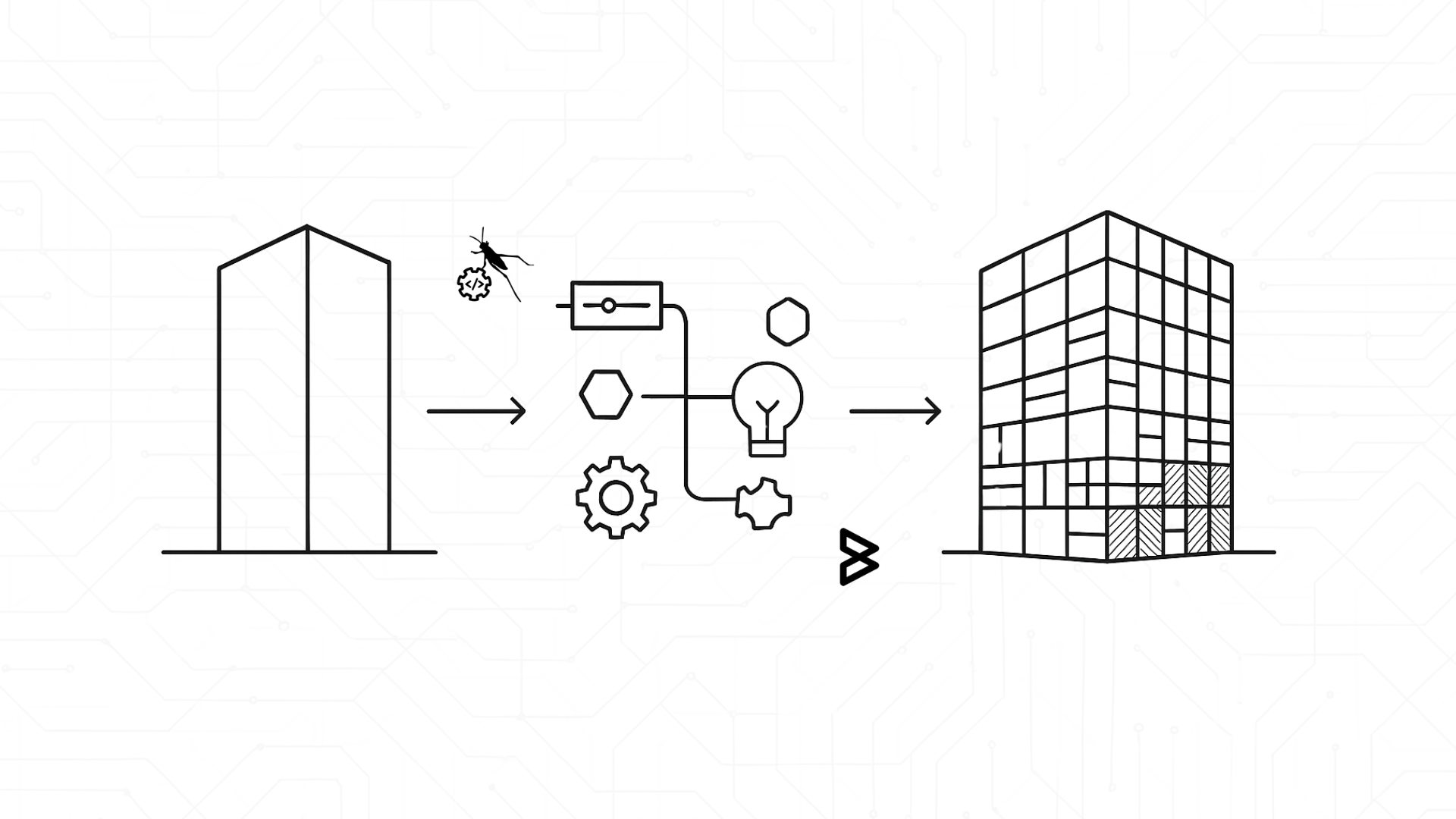
Shaping the Future of Facades with Intelligent Parametric Design
Walk through any modern city and you’ll notice something changing. Facades aren’t just flat surfaces. They bend, shift, respond, filter, protect, and sometimes even communicate. Architecture is becoming more intelligent not because designers are adding complexity, but because they’re adding logic and using tools that make that logic real, the most important of which is Grasshopper.
Grasshopper has become the backbone of modern parametric facade design. Instead of manually modeling every panel or detail, designers use Grasshopper to create rule-based systems where geometry adapts automatically. Parameters can be modified in seconds, and the entire facade responds instantly. This unlocks cleaner forms, better performance, and far more flexibility than traditional modelling ever could.
What Makes a Facade Parametric
A parametric facade doesn’t begin with isolated panels. It begins with a Grasshopper definition, a visual script that controls how the entire system behaves.
In Grasshopper, designers define the rules that drive the facade. These rules may influence:
- How modules are spaced or oriented
- How openings expand or contract
- How patterns transition across the surface
- How shading elements respond to sunlight or privacy needs
- How form adjusts across curved or irregular geometry
Grasshopper keeps all these relationships connected. One adjustment: a slider value, a domain, a rotation angle, recalculates the full model instantly. The facade becomes a coordinated system, not a collection of separate pieces.
Why Parametric Facades Matter in Today’s Architecture
Modern buildings need precision, performance, and adaptability. Grasshopper supports this by turning the facade into a responsive, data-driven system.
1. Better Performance Through Logic
Grasshopper lets designers tune facades quickly and intelligently.
With parametric control, the facade can be optimized for:
- Daylight
- Sun protection
- Thermal comfort
- Privacy
- Views
- Noise control
Because Grasshopper updates the geometry instantly, designers can explore multiple performance-driven variations without redoing the entire model.
2. Complexity Becomes Manageable
Curved forms, intricate patterns, variable modules, and deep geometries become practical when Grasshopper handles the relationships.
It coordinates thousands of elements while keeping the design structure clean and predictable.
3. Faster Iteration, Fewer Redraws
Grasshopper reduces repetitive work dramatically.
Change a parameter, update a rule, revise a pattern — the entire facade adapts.
This speeds up decision-making and maintains consistent logic through every stage of the project.
How Parametric Facades Are Actually Created

Grasshopper enables a structured, logical workflow that moves from concept to fabrication without losing clarity.
Step 1: Prepare the Base Geometry
The facade surface is cleaned and organized, ensuring Grasshopper can interpret it correctly.
Step 2: Build the Organizational Framework
In Grasshopper, designers create the logic: grids, subdivisions, attractor systems, or custom topologies.
This becomes the framework the entire facade follows.
Step 3: Define the Core Parameters
Grasshopper parameters guide the whole system. They may include:
- Panel dimensions
- Depth and extrusion logic
- Opening ratios
- Rotational behavior
- Material variation rules
- Joint and alignment strategies
These parameters shape how the facade behaves and evolves.
Step 4: Introduce Data Responsiveness (When Needed)
Grasshopper can link geometry to environmental inputs like direction, sunlight, privacy gradients, or contextual data, turning the facade into a responsive system.
Step 5: Generate Variations
Because the logic is parametric, Grasshopper can output dozens of facade variations, all consistent and buildable.
Step 6: Produce Fabrication-Ready Outputs
Grasshopper delivers clean geometry and structured outputs aligned with material sizes, tolerances, and installation requirements.
Where Parametric Facades Truly Shine
Grasshopper unlocks exceptional control in projects that need both flexibility and precision. Parametric facades excel on curved surfaces, in shading systems that must adapt to orientation, and in designs where patterns shift gradually across the building. Grasshopper makes it easy to handle deeply sculpted forms or large numbers of modules that repeat but still require subtle variation.
This tool transforms complexity into clarity. Instead of modelling each component separately, designers work with a unified logic that shapes the entire facade. The result is a system that remains coherent, efficient, and visually refined.
Beyond Aesthetics: The Real Value

Grasshopper-driven facades are not only visually striking, they’re smarter.
By embedding logic directly into the parametric system, designers ensure every part of the facade reflects the original intent. Grasshopper allows the geometry to respond naturally to sunlight, privacy needs, and building orientation, minimizing manual adjustments and potential errors.
This approach strengthens the entire workflow. Concept, development, and fabrication all benefit from consistent geometry, faster iteration, and improved decision-making. Grasshopper helps designers create complex architecture with confidence, delivering clarity at every scale.
The Borg Markkula Approach
At Borg Markkula, Grasshoppers are central to how we design. We use it to build intelligent parametric systems where geometry is guided by rules, relationships, and performance, not repetitive manual modelling. This ensures every project moves from concept to fabrication with exceptional clarity. The result is architecture that looks refined, functions intelligently, and remains precisely controlled at every stage.
Book a free 30-minute call with us to discuss your project:
Schedule here on Calendly
https://calendly.com/kane-borgmarkkula/30min?month=2025-10