



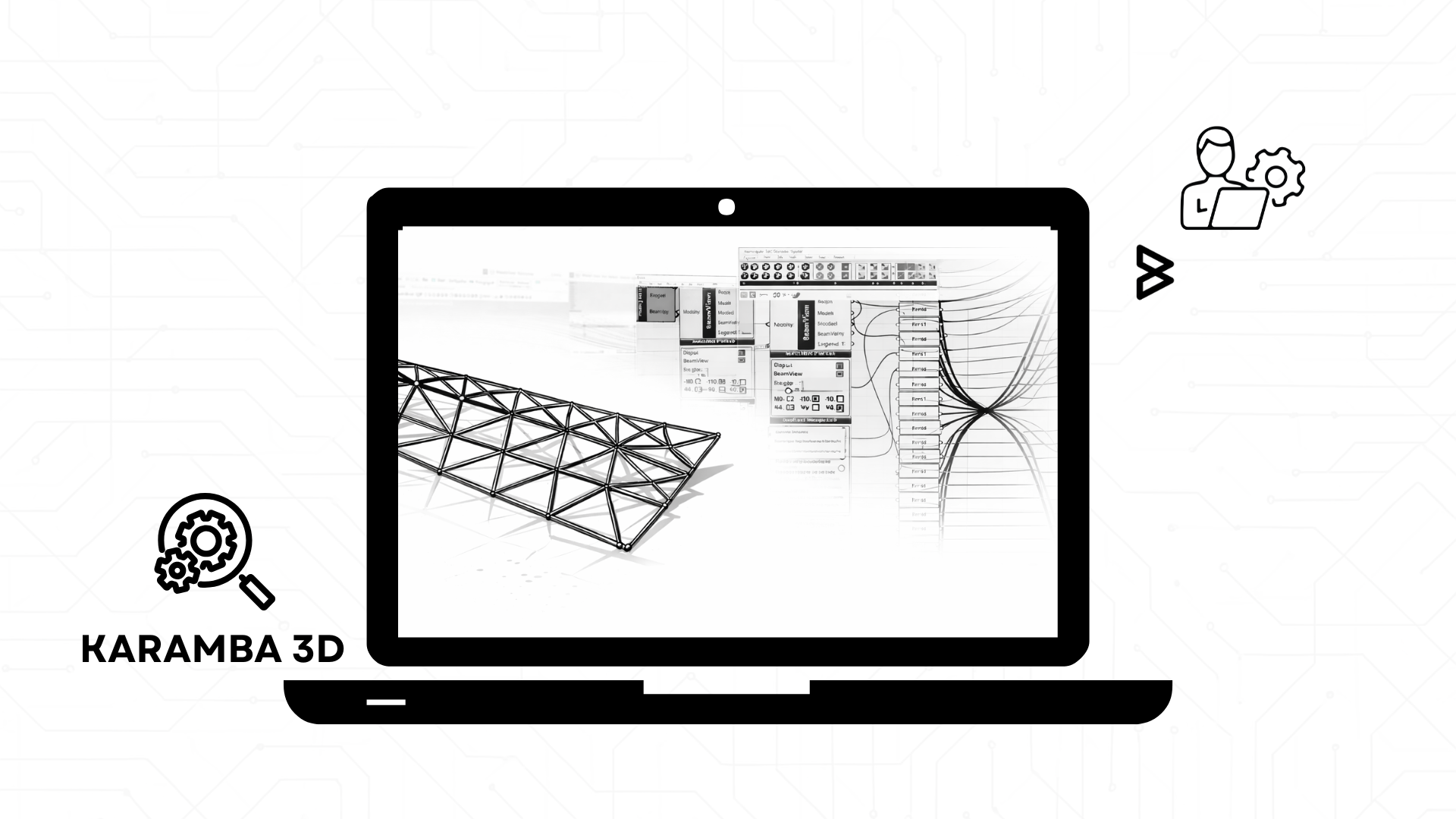
Karamba3D: Why Lightweight FEM Feels Like a Turning Point for Parametric Design
A story most designers recognize
It usually starts the same way. You open Rhino, launch Grasshopper, and begin building a system. Curves turn into logic, logic turns into structure, and suddenly you are looking at something that feels resolved. It looks efficient. It looks elegant. It feels right.
Then comes the pause.
Not because the design is bad, but because you do not yet know how it behaves. You might have an intuition, maybe even a strong one, but intuition alone is rarely enough when spans grow, loads shift, or repetition hides weaknesses. This moment, where design confidence meets structural uncertainty, is where many parametric workflows slow down.
Karamba3D exists precisely for this moment.
What lightweight FEM actually means in practice

When Karamba3D is described as a lightweight FEM, it is not a comment on accuracy or seriousness. It is a description of intent. Karamba is designed to sit inside Grasshopper and respond at the speed of design thinking. It works directly with the geometry you are already creating rather than forcing you to translate it into a separate analysis model.
In practice, this changes the workflow more than the analysis itself.
Karamba runs directly inside Grasshopper, allowing designers to test structural behavior without leaving the parametric environment. Geometry can be rationalized, adjusted, and reinterpreted on the fly, using the same definitions that generate the form.
Structural feedback updates as parameters change, making it easier to explore alternatives while the system is still flexible.
There is still some rationalization involved. Geometry often needs to be interpreted as lines or meshes to make structural behavior readable.
The difference is when and where this happens. Instead of exporting models and rebuilding them later, these adjustments happen directly inside Grasshopper, while the design is still evolving. Analysis becomes part of exploration rather than a formal checkpoint after decisions are already set.
Why early structural feedback changes the quality of design
In many projects, structure is introduced once a visual direction has already been chosen. At that point, analysis often feels like a test to pass rather than a guide to follow. Karamba shifts this sequence by allowing structural behavior to inform design while it is still fluid.
When feedback arrives early, small adjustments can have a big impact. Changing a support condition, altering a span, or redistributing members immediately shows how forces flow through the system. Designers begin to see patterns instead of isolated results, and those patterns influence better geometry decisions.
This is not about producing final calculations. It is about developing structural intuition alongside form.
How Karamba is actually used in real-world workflows
Karamba is most commonly used during concept design and parametric system development. It proves especially valuable for lightweight frames, grids, space structures, and façade systems where repetition can mask inefficiencies.
Teams use it to:
- Compare multiple structural logics early.
- Identify weak or overworked members before detailing.
- Understand how geometry and performance influence each other.
- Communicate design intent more clearly across disciplines.
One of the less obvious benefits is collaboration. Designers become more comfortable discussing forces and stiffness, while engineers engage earlier with parametric geometry that is still open to refinement. The Grasshopper definition becomes a shared workspace rather than a handoff.
The insights designers often discover along the way

Once structural feedback becomes part of everyday design, certain patterns tend to repeat:
- Inefficient load paths reveal themselves quickly.
- Overly complex geometry becomes harder to justify.
- Simpler systems often perform better than expected.
- Design decisions feel more confident and defensible.
This shift reduces late-stage revisions and helps teams move forward with greater clarity. Structure stops being something that interrupts the design process and starts becoming something that shapes it.
This approach closely aligns with how Borg Markkula works with parametric design and digital engineering. Structural analysis is not treated as a final validation step but as an active design input that evolves alongside geometry. By integrating tools like Karamba into early workflows, performance thinking becomes part of creative thinking.
Lightweight FEM does not mean lightweight thinking
It is important to be clear about what Karamba is and what it is not. It does not replace detailed finite element software, building code checks, or professional engineering judgment. Its strength lies earlier in the process, where direction matters more than precision.
By the time a design reaches detailed analysis, many of the critical decisions have already been shaped by early feedback. Karamba helps ensure those decisions are informed rather than assumed.
Conclusion
Karamba3D has changed how parametric designers and engineers interact with structure inside Grasshopper. By embedding lightweight FEM directly into the design environment, it allows teams to explore, test, and refine ideas before they become expensive to change. When structure is invited into the process early, it stops feeling like a constraint and starts behaving like a collaborator.
For teams working at the intersection of geometry, performance, and computation, that shift is not minor. It fundamentally changes how design decisions are made.