



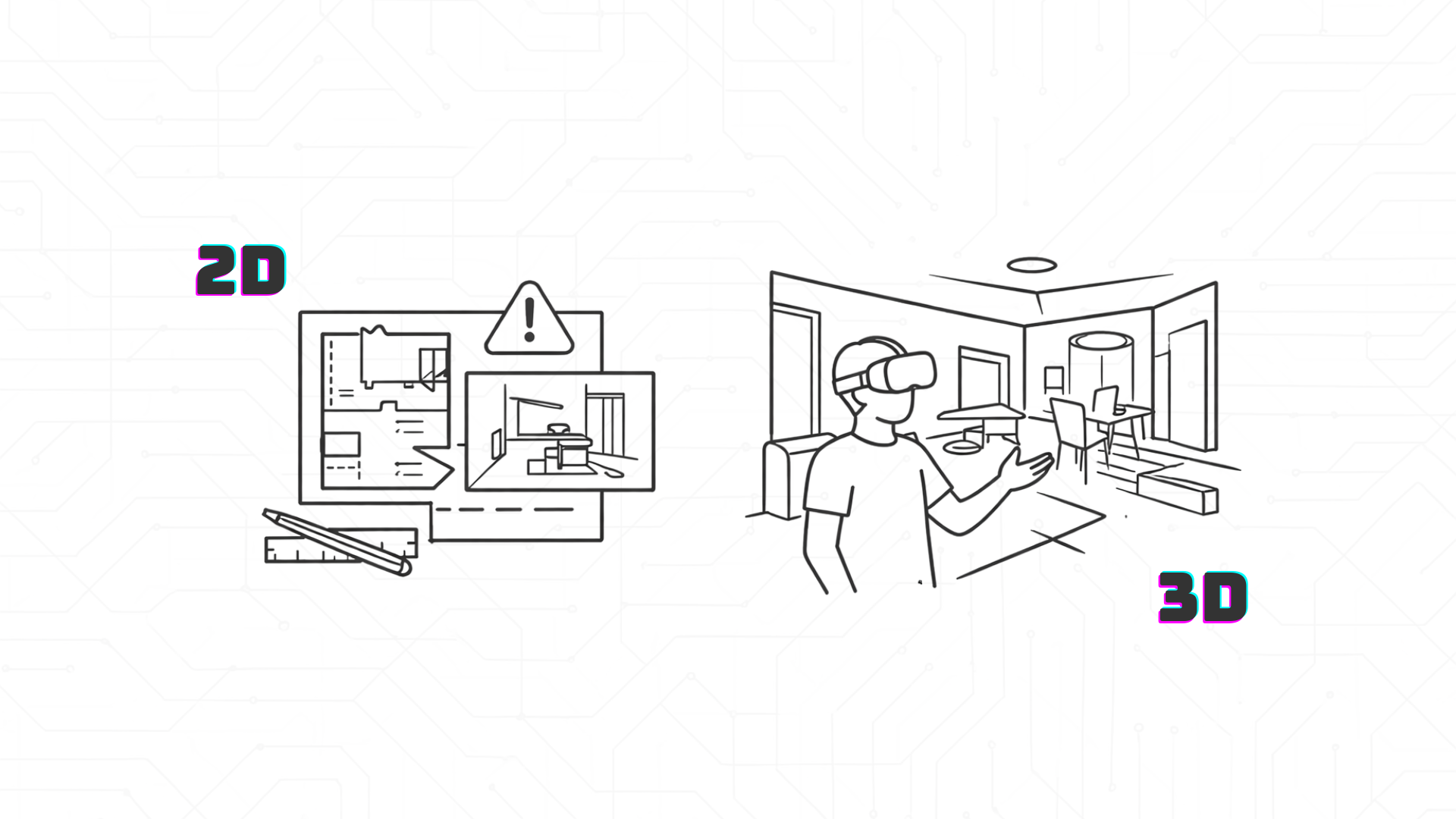
VR Fixes a Communication Problem Designers Have Ignored for Years
If you work in architecture, interiors, or any branch of computational design, you’ve probably had this moment:
You show a fully developed render. The client nods. They approve. Months later on site, they walk in and say something like:
“I didn’t realize the ceiling would feel this low.” on the dramatic end of reactions.
And you stand there thinking: It was literally in every drawing.
That mismatch isn’t stupidity or lack of imagination. It’s simply that most clients don’t have the spatial literacy designers spend years building. They don’t automatically process scale from 2D or even photorealistic 3D.
VR doesn’t make the design better. It removes the translation layer between your brain and theirs.
Clients Don’t Read Space the Way Designers Do (And That’s Fine)
Designers develop a weird skill set over time. We read 35-degree camera lenses, orthographic projections, sections, and we instantly map everything to human scale. We know what 2.4 meters feels like because we’ve built enough rooms to have a mental database.
Most clients don’t get that experience until construction.
VR moves that experience forward so decisions can happen when they’re cheap, not when they’re poured in concrete.
The Moment VR Changes the Conversation

When a client puts on a headset, something interesting happens. Their feedback shifts.
Traditional review:
- “Can we make the walls lighter?”
- “Maybe bigger windows?”
- “Will this look modern enough?”
VR review:
- “This corridor feels tight.”
- “I can’t see the signage from here.”
- “Two people can’t pass comfortably in this area.”
- “That mezzanine feels more open than I expected.”
Same design. Completely different conversation.
This is the part where you see why VR matters in real practice. It moves feedback from aesthetics to experience.
And experience is where real design is approved or rejected.
It Doesn’t Replace Drawings. It Complements Them.
Anyone who says VR replaces drawings hasn’t built anything real. Drawings still communicate tolerances, structure, dimensions, details, compliance. VR just adds the missing human layer:
“What does it feel like to stand here?”
It does it without the client needing to be experienced in the medium
The Interesting Part for Experts: VR Shifts Risk Upstream
Project risk rarely comes from bad ideas. It comes from misaligned expectations.
VR improves expectation alignment in three practical ways:
- Scale Becomes Obvious
Clients understand height, width, and circulation without guessing. You don’t need to explain what 800 mm feels like. They just walk through it. - Decisions Move Earlier
Material swaps, openings, furniture placement, signage visibility, and wayfinding get resolved during design, not on site. - Iterations Become Insightful
Instead of “Can we try a lighter color?” you get “This bench interrupts circulation during peak hours.” One is cosmetic. The other is functional.
Less chaos, fewer surprises, more meaningful collaboration.
Here’s the Part Designers Don’t Always Admit: VR Also Shows Our Blind Spots

Every experienced designer has had a moment where VR reveals something we didn’t see on a flat screen. For example:
- Circulation pinch points
- Awkward adjacency
- Blocked sightlines
- Low perceived headroom
- Wayfinding confusion
- Spatial compression around furniture
These don’t show up in static renders because renders are curated. Camera angles are chosen. Lenses are friendly. VR doesn’t care. VR gives you the uncomfortable first-person truth.
It’s humbling, but it makes the work better.
The Limitations Are Real (And They Matter)
VR isn’t magical. It has friction:
- Clients need to come to your setup
• Hardware needs care
• Models sometimes need cleanup
• Lighting may not match reality
• Interaction can be clumsy
• Not every stakeholder is comfortable with headsets
But compare that to the cost of misalignment during construction. VR friction is nothing compared to rework, delays, or unhappy clients holding drawings on site saying “This isn’t what I imagined.”
Where VR Quietly Shines: Multi-Stakeholder Projects
In projects with multiple voices, developers, operators, clients, branding teams, fabricators, VR does something really valuable:
It equalizes the playing field.
Everyone sees the same thing. No one is guessing from PDFs. The signage team can talk to the interior designer about visibility. The operator can point out collision zones. The client can understand volume without imagining it.
That level of shared understanding is rare in design.
Forward Looking: VR is the First Step, Not the Endpoint

What’s happening now is interesting. Teams are starting to move beyond solo VR and into:
- Multi-user VR walkthroughs
• VR for pre-construction QA
• VR paired with BIM coordination
• VR validation before fabrication
• VR for training and operations
• XR overlays on actual construction sites
So while today VR feels like a presentation tool, tomorrow it becomes part of the pipeline. Not because it’s trendy, but because it reduces ambiguity at scale.
And if there’s one thing clients, contractors, and designers can agree on, it’s that ambiguity is expensive.
Final Thought
The real value of VR is clarity.
Every designer wants clients who understand what they’re approving. VR just makes that possible without waiting for scaffolding to come down.
And in a field where time is money and misunderstandings travel fast, that’s not innovation.
That’s just common sense.
Borg Markkula works at the intersection of architecture, computational design, and digital fabrication. We use VR, parametric modeling, and advanced visualization to help clients evaluate space, understand scale, and make confident decisions before construction begins.
If your project involves complex spatial experience or multi-stakeholder coordination, we’re always open to a conversation.