




Grasshopper Myths #2: Is It Really Just for Futuristic Voronoi Geometry?
If you tell a client you are using Grasshopper to design their new office, they might panic and picture a building that looks like a giant, futuristic cheese grater.
Welcome to the second post in our Grasshopper Myths series! Today, we are taking a sledgehammer to the most common misunderstanding in the 3D modeling world: the idea that Grasshopper is only built for generating wild, web-like, Voronoi geometry.
We all know that organic, cellular pattern that makes a structure look like an alien spaceship or a melting honeycomb. Because Grasshopper makes it incredibly easy to spit out these complex shapes, it quickly got pigeonholed as a tool strictly for “crazy” architecture.
But treating Grasshopper like a fancy sci-fi shape generator is like buying a top-tier smartphone just to use the calculator app.
Here is the truth: Grasshopper is actually a behind-the-scenes workhorse for perfectly normal, everyday design problems. It is less about making things look weird, and more about making your work incredibly efficient. Let’s break down what this tool actually does best.
The Ultimate, Boring (But Brilliant) Time-Saver
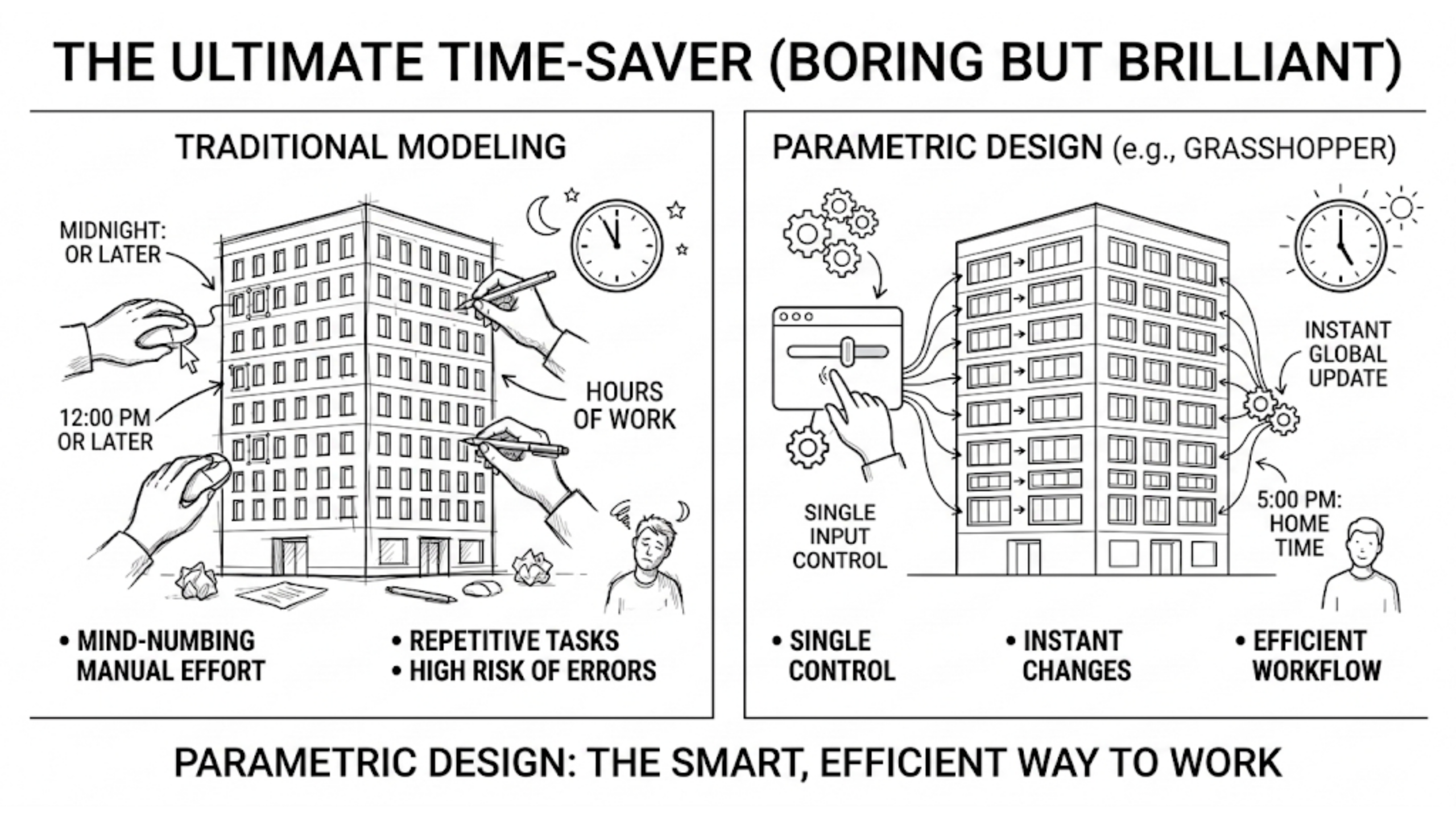
Forget the futuristic blobs for a second. Imagine you are working on a standard, rectangular apartment building. You have 500 windows, and the client just decided they all need to be two inches wider and moved slightly to the left.
In traditional modeling, you are looking at hours of mind-numbing manual work to click, drag, and copy and paste every single window. You might miss one, make a mistake, and pull your hair out in the process.
With Grasshopper, you simply drag a slider to change a single number, and all 500 windows update instantly. It doesn’t make the building look like a spaceship; it just lets you go home at 5 PM instead of midnight. It is parametric design at its core: building smart relationships between parts of your project so that when one thing changes, everything else reacts naturally.
The Spreadsheet Whisperer
Design is rarely just drawing lines; it is managing numbers, budgets, and materials. Grasshopper is fantastic at math and lists.
If you need to count how many parking spaces can legally fit on an awkwardly shaped lot, Grasshopper can test hundreds of variations and draw the most efficient layout for you. Need to extract the exact square footage of every single room, door frame, and floorboard into an Excel sheet for the budget team? Grasshopper does that without breaking a sweat. It handles the boring math so you can spend your time actually designing.
Real-World Insights: Grasshopper in the Wild
To prove this isn’t just theory, here is a look at how real, world-class studios and engineers use Grasshopper to solve grounded, practical problems:
- Taming Construction Costs (Facade Rationalization): When designing complex building facades, architects often face thousands of panels that appear slightly different. Using Grasshopper, designers can analyze the geometry and group similar panels into fabrication “families.” Instead of manufacturing thousands of unique molds, fabricators only need a small set of repeatable panel types. This dramatically reduces manufacturing complexity, lowers tooling costs, and makes large-scale architectural facades far more affordable to build.
- Cutting Energy Bills (Ladybug & Honeybee): Some of the most common Grasshopper plugins have nothing to do with geometry. Environmental analysis tools like Ladybug use Grasshopper to run heavy climate data. Architects use this on completely normal office buildings to figure out exactly where the sun will hit the windows at 2 PM in July. This data tells them exactly how deep to make their window shades, drastically cutting down on standard air conditioning costs.
- Wiping Out Drafting Typos: In large commercial projects, human error is expensive. Firms frequently write simple Grasshopper scripts purely for administrative tasks like automatically labeling hundreds of doors and windows based on their size and location. This completely removes the chance of an intern accidentally labeling two different doors as “Door 104,” avoiding costly mistakes on the construction site.
The Secret to Making It Work: Borg Markkula
You might be thinking, “This sounds great, but I don’t have the time to learn visual programming.” That is exactly where experts like Borg Markkula step in. As a top-tier computational design and consulting team, Borg Markkula builds custom tools, scripts, and proprietary plugins specifically for Rhino and Grasshopper.
Whether you need to automate your daily drafting tasks, set up a custom web shop for your products, or figure out the math for a complex landscape design, they do the heavy lifting for you. They build the exact custom workflows your studio needs to save hours of manual work. This means you get all the massive time-saving benefits of Grasshopper without the steep learning curve of figuring it out yourself.
The Final Verdict
Yes, Grasshopper can make your project look like a futuristic honeycomb if you want it to. But 90% of the time, it is being used by brilliant designers and powered by custom to build totally normal, highly functional buildings faster, cheaper, and with far fewer headaches.
It is not an alien technology meant to hijack your design style. It is simply a smart assistant that takes the heavy lifting off your plate, tracks the data you hate tracking, and gives you your free time back.